
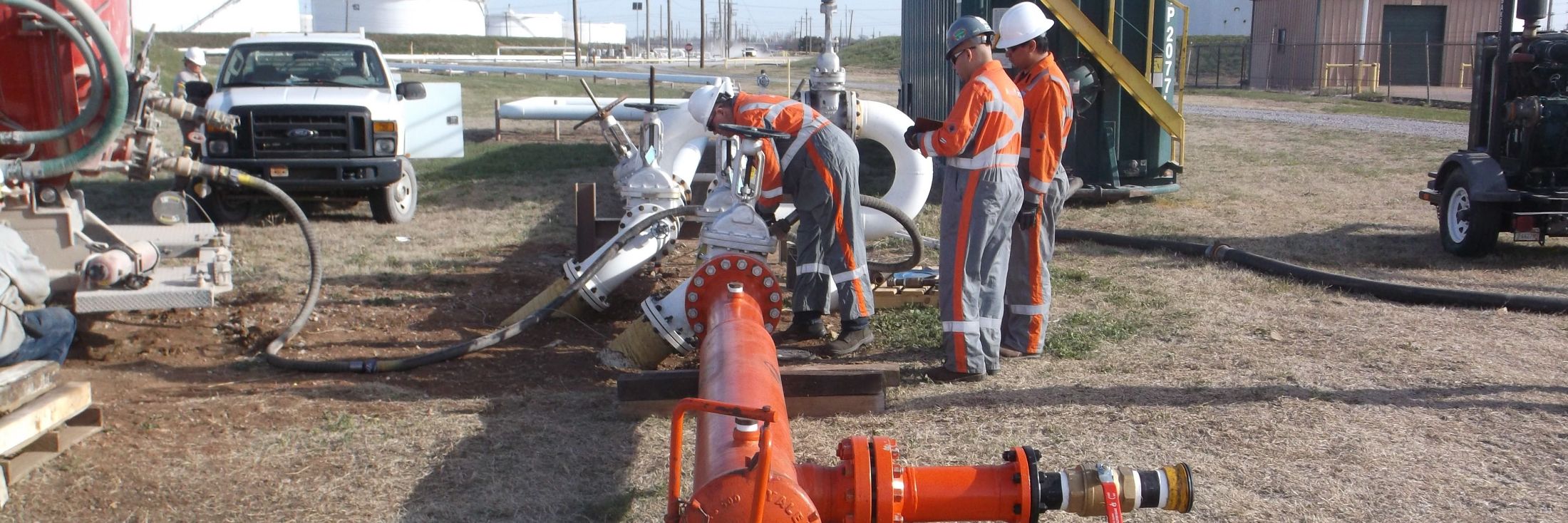
Advanced NDT
Advanced Non-Destructive Testing (ANDT): faster inspections, lower costs, zero operational downtime
Advanced Non-Destructive Testing (ANDT) makes it possible to detect anomalies in pipelines, welds, pressure vessels and structures in service, without interrupting the production process. When a critical asset cannot be taken out of service, ANDT adapts the inspection to the operation — not the other way around.
Compared to conventional NDT methods, ANDT reduces inspection time, eliminates unnecessary shutdowns and lowers the total cost of maintenance. Applus+ has been developing the methods, technologies and procedures that make this inspection possible since 1937. Every method has responded to a specific inspection challenge that existing market solutions could not resolve — developed directly with client operations teams.
What is advanced non-destructive testing (ANDT) and how does it differ from conventional NDT?
Conventional NDT — ultrasonics, magnetic particle inspection, liquid penetrant testing, radiography — are well-established techniques that in many cases require direct access to the asset or process shutdown. ANDT uses higher-resolution and wider-coverage technologies — phased array, real-time digital radiography, high-resolution eddy current, continuous corrosion mapping — that allow in-service assets to be inspected with greater speed, less operational disruption and more precise results.
The practical difference is significant: conventional NDT confirms whether a defect is present. ANDT characterises its nature, exact location, dimensions and evolution over time — without stopping the installation.
Which ANDT technique applies to each industrial inspection challenge?
Selecting the right method depends on the asset type, material properties, geometry and specific inspection objective. Applus+ assesses each case individually to determine the technique that delivers the most accurate results with the least possible operational disruption.
|
Operational challenge |
ANDT technique |
Key advantage |
|
Active corrosion in in-service pipelines |
DTI Trekscan | Continuous thickness mapping without removing insulation. |
|
Weld validation before plant start-up |
Portable IWEX | Phased array at any location, no shutdown required. |
|
Tube bundle inspection in heat exchangers and boilers |
IRIS | High-resolution tube-by-tube ultrasonics. |
|
Radiographic testing without film or exclusion zones |
Rayscan | Real-time digital radiography |
|
Internal pipeline assessment without external access |
PIT |
Inspection from the inside, no excavation required. |
What are the proprietary ANDT technologies developed by Applus+?
Applus+ has developed a suite of advanced inspection technologies available exclusively to its clients. These methods have been designed to meet the most demanding inspection requirements in sectors including Oil & Gas, petrochemicals, LNG storage and power generation.
|
Techology |
Description |
Primary application |
|---|---|---|
|
Rayscan |
Real-time digital radiography (RT) | Welds and internal structures, no film, no waiting |
| DTI Trekscan | Corrosion mapping and continuous thickness measuremen | In-service pipelines with insulation |
| PIT - Pipeline Inspection Tool | Internal pipeline inspection | Without removing insulation or excavation |
| IRIS | Ultrasonic tube inspection | Heat exchangers and boilers |
| Portable IWEX | Phased array weld inspectio | Any location, no shutdown required. |
Can ANDT inspection be carried out during a plant shutdown or turnaround?
Plant shutdowns and turnarounds have a fixed execution window. Applus+ operates with ANDT inspection protocols specifically designed for this context: rapid mobilisation, technicians qualified in advanced methods and real-time delivery of results, so that maintenance decisions are not held up by the final report.
If the next shutdown requires inspection of pressure vessels, pipelines, welds or structures under API 510, API 570 or ASME standtrds, the Applus+ team can be integrated into the work plan from the planning stage.
Do Applus+ ANDT services comply with API, ASME and ISO standtrds?
Yes. Applus+ ANDT services comply with the main international inspection standtrds, including API 510 (pressure vessels), API 570 (process pipelines), API 653 (storage tanks) and applicable ASME codes. Applus+ technicians hold the qualifications required by each standtrd and apply the same criteria across all locations where the company operates.
Why choose Applus+ for advanced non-destructive testing services?
- Proprietary technologies: methods developed in-house, not subcontracted or licensed to third parties.
- Regulatory compliance: API, ASME, ISO. The same inspection standtrds in any country where the client operates.
- Inspection without operational interruption: all Applus+ ANDT methods are designed for in-service assets.
- Real-time results: inspection data is available during the process, without waiting for the final report.
- Operations-focused R&D: the Applus+ Technology Centre develops solutions based on real operational problems raised by client integrity and operations teams.
Which industries can benefit from Applus+ ANDT services?
Applus+ ANDT services are available for Oil & Gas — upstream, midstream and downstream —, petrochemicals, LNG storage, nuclear, thermal and renewable power generation, mining and the process industry in general. Applus+ operates in more than 70 countries with the same inspection protocols, the same accreditations and the same quality standtrds at every location.
Frequently asked questions about the ANDT service
Can Applus+ work under the client's own inspection procedures?
Yes. Applus+ can execute inspections under client-developed procedures, provided they are compatible with the applicable standtrds. In Oil & Gas and petrochemical projects, it is common for plant operators to have their own approved procedures — Applus+ can carry out the inspection under those procedures without developing parallel documentation.
What qualifications do Applus+ ANDT technicians hold?
Applus+ ANDT technicians hold internationally recognised qualifications including certifications under ISO 9712, PCN and the qualification schemes required by standtrds such as ASME Section V. Depending on the project and region, client-specific qualifications required by major energy and petrochemical operators are also managed.
How far in advance does an ANDT campaign need to be planned for a scheduled shutdown?
The recommended lead time depends on the inspection scope and the availability of qualified equipment and technicians. For plant shutdowns with significant scope, a minimum of eight to twelve weeks advance planning is recommended. This allows inspection procedures to be aligned, the availability of specific required technologies to be confirmed, and the documentation necessary for regulatory compliance to be coordinated.
Are Applus+ ANDT reports valid for integrity audits before the regulator?
Yes. Reports issued by Applus+ comply with the documentation requirements established by the applicable API, ASME and ISO standtrds, and are signed by technicians holding the required qualifications. They are valid for integrity audits, equipment recertification processes and regulatory reviews in the sectors in which the company operates.
Can Applus+ inspect assets across multiple countries under a single contract or service framework?
Yes. Applus+ operates in more than 70 countries with the same technical standtrds, the same accreditations and the same inspection protocols. For clients with multinational operations, this makes it possible to standtrdise the integrity programme — same method, same qualification, same report format — regardless of the location of the asset.
What happens if a defect requiring immediate action is detected during an ANDT inspection?
Applus+ delivers inspection results in real time during the campaign. If an anomaly is detected that requires immediate assessment, the technical team can issue a preliminary field report so that the client can make maintenance or operational decisions without waiting
for the final report to be closed. Where required, Applus+ can complement the inspection with integrity consulting and fitness-for-service assessment services.
SERVICES
Applus+ uses first-party and third-party cookies for analytical purposes and to show you personalized advertising based on a profile drawn up based on your browsing habits (eg. visited websites). You can accept all cookies by pressing the "Accept" button or configure or reject their use. Consult our Cookies Policy for more information.
-
Essential cookies
They allow the operation of the website, loading media content and its security. See the cookies we store in our Cookies Policy.
Always active -
Analytics cookies
They allow us to know how you interact with the website, the number of visits in the different sections and to create statistics to improve our business practices. See the cookies we store in our Cookies Policy.